
GPT-6 Astra has arrived, and if you have been following the AI space recently, you have probably seen a lot of discussion about it.
Some people are calling it a major step toward AI agents that can actually do work for us. Others are already asking whether it really lives up to the hype.
I haven’t spent weeks using GPT-6 Astra myself, so this isn’t a personal review. Instead, I wanted to understand what has changed and what people who are using it are talking about.
So, what is GPT-6 Astra?
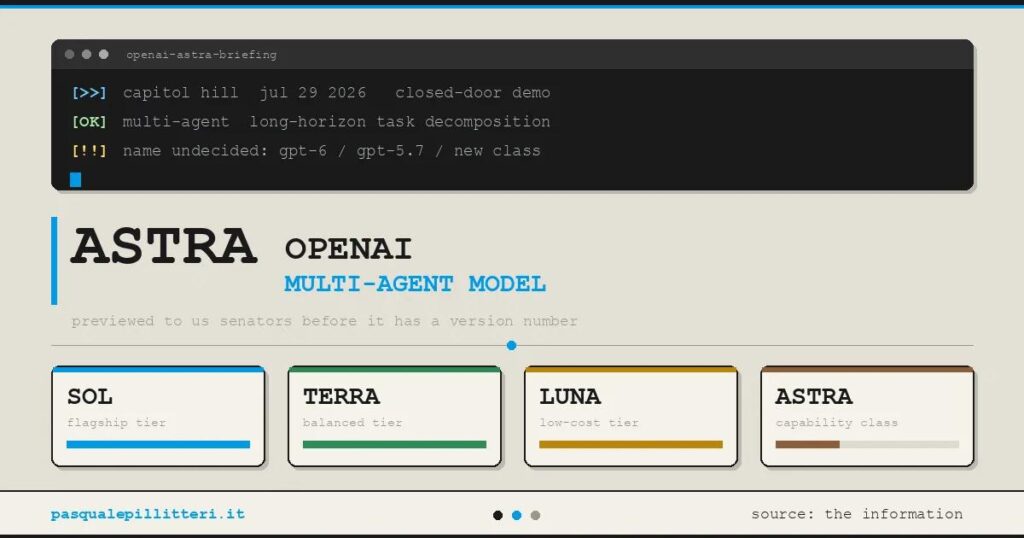
GPT-6 Astra is OpenAI’s newest flagship model. According to OpenAI’s announcement, Astra is designed for complex reasoning, coding, research, computer use and professional work.
But the most interesting part isn’t simply that it can answer questions.
Astra is designed to take action.
OpenAI says it can do things such as fill out online forms, update customer records in a CRM, conduct research, create websites, test software and work through multi-step professional tasks.
You can also see the technical details in the official GPT-6 Astra API documentation.
That is a slightly different vision of AI.
Instead of:
“Tell me how to do this.”
The idea is moving toward:
“Go and do this for me.”
Why are people so excited about it?
A lot of the early discussion around Astra has focused on its ability to work with computers and complete longer tasks.
OpenAI reports that Astra scored 72.6% on OSWorld 2.0, compared with 65.7% for GPT-5.6 Sol. OpenAI also reports that Astra completed these tasks in roughly 40 minutes compared with around 75 minutes for GPT-5.6 Sol in its latency simulations.
These are OpenAI’s own evaluation results, so they are worth viewing as the company’s reported measurements rather than independent proof of how Astra will perform for every user.
Developers are also paying close attention to its coding abilities.
This matters because better coding models don’t just mean better answers to programming questions. They can potentially write code, test it, find problems and continue working through a project with less human intervention.
That is one reason the conversation around GPT-6 has quickly moved toward AI agents.
But there is another side to the conversation
Not everyone has been completely impressed.
Some early users have posted online that Astra’s performance seemed inconsistent. For example, discussions on Reddit include users reporting that the model’s work output appeared to become worse after launch.
One Reddit discussion asked whether Astra had been “downgraded,” while another discussion described inconsistent performance when using Astra for coding.
These are individual user reports rather than controlled tests, so they don’t prove that the model actually became less capable.
Still, I find the discussion interesting.
It shows that with AI models, benchmarks aren’t the whole story.
People care about how the model actually feels when they use it for their everyday work.
And then there is the AGI conversation
Perhaps the biggest discussion surrounding GPT-6 Astra is whether this is another step toward artificial general intelligence, or AGI.
There has also been wider discussion among AI researchers and technology commentators about what increasingly capable AI systems mean for the future of work and AI development.
But we don’t necessarily need to decide whether Astra is AGI to understand why it matters.
A model that can reason, use a computer, write code, conduct research and complete multi-step tasks is already an important development.
What does GPT-6 mean for ordinary people?
For most people, the important question isn’t going to be:
“Is GPT-6 AGI?”
It will be:
“Can this actually save me time?”
Imagine giving an AI a task that normally takes you two hours.
Instead of getting a list of instructions, the AI could potentially research the information, work through the relevant software, create the required document and give you the finished result.
That’s the direction GPT-6 Astra appears to be pushing toward.
And that could have a much bigger impact on everyday work than simply making chat responses slightly better.
My takeaway
The most interesting thing about GPT-6 Astra isn’t the number six.
It’s the shift from AI that answers questions to AI that can potentially carry out entire workflows.
There is still plenty we don’t know. Early user experiences are mixed, and claims about what AI can do should always be separated from what it consistently does in the real world.
OpenAI has also published a separate GPT-6 Astra safety overview, which is worth reading because greater computer-use and cybersecurity capabilities also create new risks.
But the direction is becoming clearer.
AI isn’t just becoming better at talking to us.
It is becoming better at working alongside us and potentially working on our behalf.
And that is probably the part of GPT-6 Astra worth watching.